AI Can Create Beautiful Images. It Can't Design Your Home.
Artificial intelligence is everywhere these days, and interior design is no exception. Scroll through social media and you'll find countless examples of AI-generated living rooms, kitchens, and bedrooms that look stunning at first glance. With just a few prompts, AI can create beautiful, photorealistic spaces that seem straight out of a magazine.
As an interior designer, I don't see AI as something to fear. In fact, I use it myself.
Recently, I used AI for the first time to transform a SketchUp model of a custom built-in cabinet into a photorealistic rendering for a client presentation. We were meeting to finalize the cabinet details before I sent the specifications to the fabricator, and the rendering helped communicate my design concept even more clearly. AI was a valuable visualization tool, but it wasn't responsible for the design itself. It didn't understand the client's specific storage needs, the nuances of the space, or the dimensions required to make the piece both beautiful and functional. Those decisions came from my experience, expertise, and understanding of the project. I was grateful for the tool because it helped me convey the design, but it didn't create it.
The experience got me thinking of how I could continue to incorporate the use of AI in my design practice.
My first attempt at using AI
So, I decided to take a hand drawing of an apartment living room I designed years ago in design school and see what AI could do. I thought this would be fun to do because this was not a design that was ever meant to materialize in real life, but had always lived in my imagination. So, I gave AI some instructions, gave it the wallpaper to use and viola, there was the living room. It’s still better in my head, but I think it did a pretty good job with the rendering.
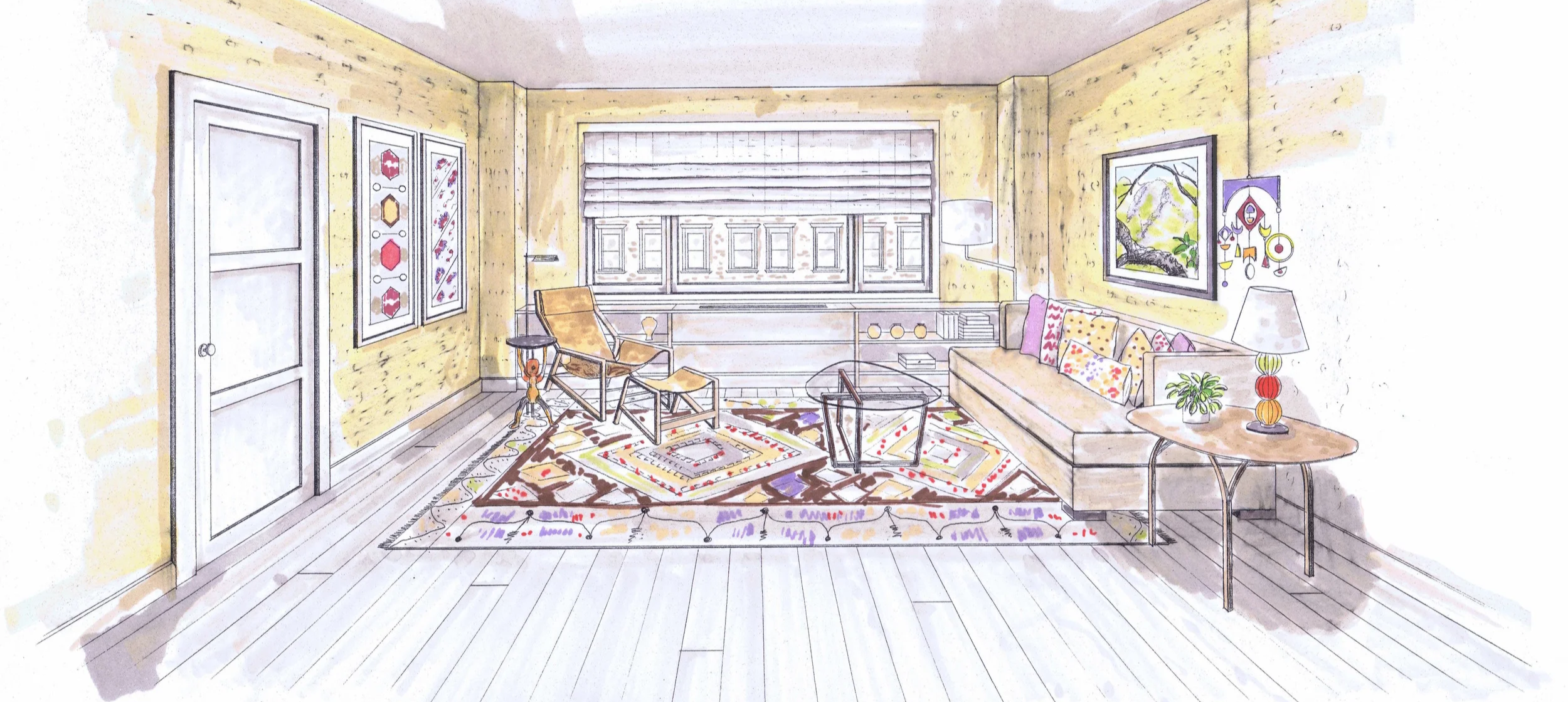
Hand-drawing of living room by designer Christine Ortiz
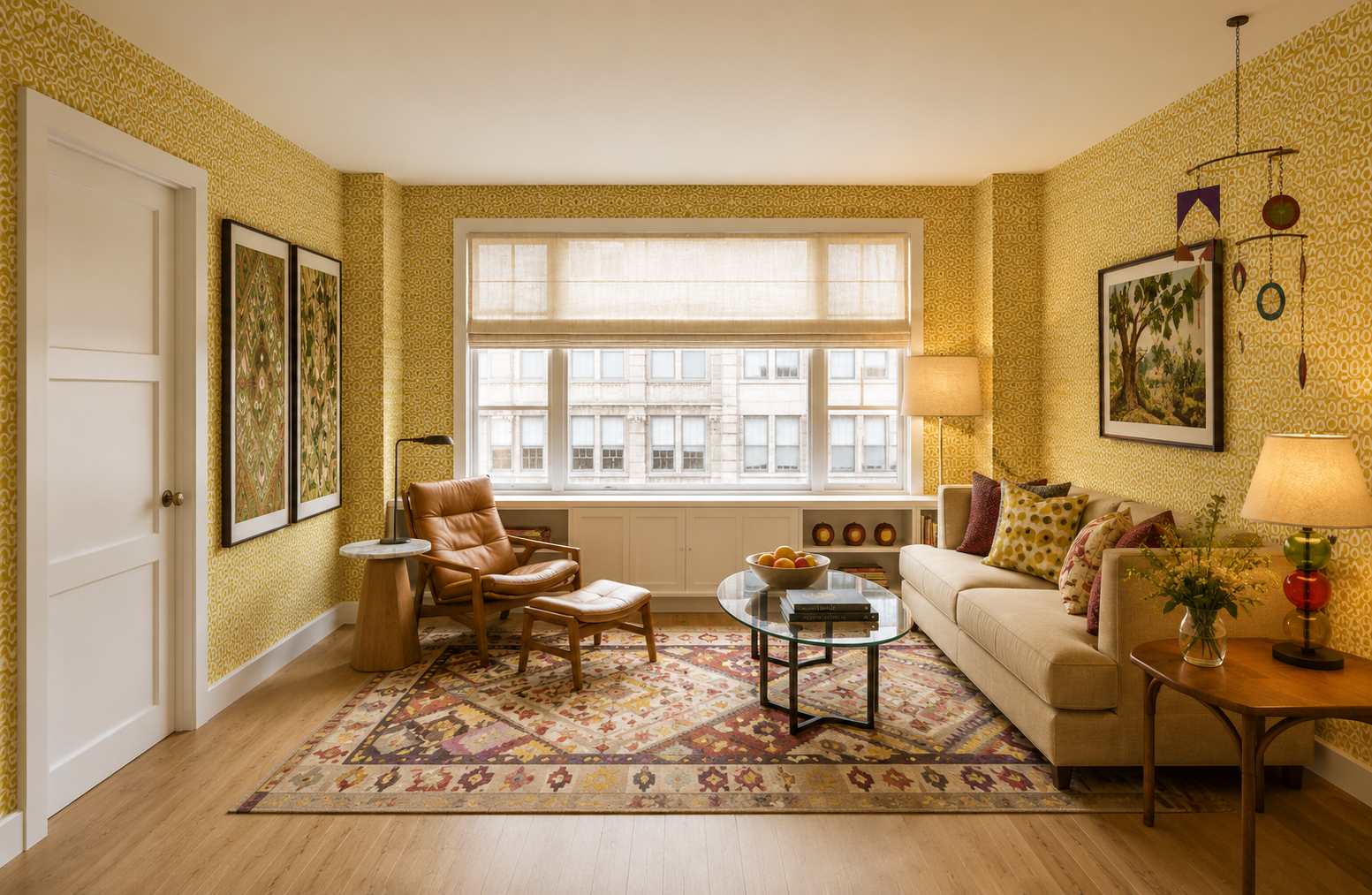
AI-generated image using a hand-drawn design by Christine Ortiz
Take Away: AI is clearly a fantastic visualization tool.
I will use AI in my design process moving forward. In fact, many of the design tools I already use and subscribe to have been doing the work of upgrading their AI capabilities.
I am all for it!
What AI does well.
Faster exploration of design concepts.
Generates multiple style variations quickly.
Helpful for communicating ideas to clients.
Using AI as a visualization tool is terrific, however, AI doesn’t know your home, your lifestyle, or budget.
What AI Cannot Do
1. Understand How You Actually Live
AI can generate a beautiful room. It cannot ask questions like:
Do you host large family gatherings?
Do you have dogs that destroy delicate fabrics?
Do you need a space that works for both remote work and entertaining?
Are your children likely to climb on that furniture?
Is accessibility a concern?
Design starts with understanding people, not pictures.
2. Solve Real Problems
Interior design is problem-solving. Examples:
Improving traffic flow.
Making a small room feel larger.
Creating enough storage.
Correcting poor architectural features.
Addressing awkward room layouts.
Improving lighting conditions.
Accommodating changing family needs.
AI can generate attractive images but cannot diagnose the underlying problems that make a space frustrating to live in.
3. Understand Scale and Proportion
One of the biggest weaknesses of AI-generated rooms.
AI routinely creates:
Oversized furniture.
Undersized rugs.
Impossible ceiling heights.
Incorrect window proportions.
Furniture arrangements that don't fit the room.
A designer understands:
Proper furniture dimensions.
Circulation clearances.
Ergonomics.
Human scale.
Architectural proportions.
A room that looks good on an AI generated image may not work in reality without an expert eye to catch what won’t work.
4. Understand Materials
AI doesn't understand performance.
A designer knows:
Which fabrics are suitable for pets and children.
Which stone stains easily.
Which finishes hold up in bathrooms.
Which wood species dent easily.
Which materials age beautifully.
Which materials are appropriate for a particular climate.
A gorgeous image is meaningless if the materials fail or were not appropriate choice.
5. Coordinate Contractors and Trades
AI doesn't attend site meetings. It doesn't:
Review shop drawings.
Answer contractor questions.
Coordinate electricians.
Work with cabinet makers.
Communicate with plumbers.
Resolve field conditions.
Design projects succeed because professionals coordinate hundreds of decisions throughout construction.
6. Handle Real-Time Problems
Every project encounters surprises. Examples:
A beam appears where no beam was expected.
Flooring is discontinued.
Furniture arrives damaged.
Lead times change.
Measurements are incorrect.
Existing conditions differ from plans.
AI cannot adapt, negotiate, or problem-solve when reality doesn't match the rendering.
7. Manage Procurement
This is one of the most overlooked parts of design.
AI does not:
Place orders.
Verify specifications.
Track shipments.
Inspect products.
Handle returns.
Resolve freight damage.
Coordinate deliveries.
Professional designers spend countless hours ensuring products arrive on time and arrive correctly.
8. Oversee Installation
The most beautiful design can fail during installation.
A designer helps ensure:
Artwork is hung properly.
Furniture placement feels balanced.
Lighting is installed correctly.
Window treatments fit perfectly.
Styling feels intentional.
AI generates images. Designers bring those images to life.
9. Build Relationships and Trust
Design is personal.
Clients share:
Budgets.
Priorities.
Concerns.
Family dynamics.
Lifestyle habits.
A successful project often depends on:
Listening.
Empathy.
Communication.
Managing expectations.
Building trust.
AI cannot replace the human relationship at the heart of great design. The future isn't AI versus designers. It's designers using AI to better serve their clients.
The Future Is AI led by Human Expertise
I believe AI will continue to become an increasingly valuable tool in the design industry.
It helps clients visualize possibilities.
It improves communication.
It allows designers to explore ideas more quickly.
Those are exciting developments.
But AI is still a tool.
Just as drafting software didn't replace designers, AI won't replace designers either.
The true value of interior design has never been the drawings, renderings, or presentations.
The true value lies in understanding people, solving problems, making informed decisions, coordinating countless details, and transforming ideas into spaces that genuinely improve how people live.
I will continue using AI because it helps me communicate my vision more effectively.
But the vision itself still comes from experience, creativity, training, and a deep understanding of my clients.
I will continue incorporating AI into my practice and am grateful for the time it saves when helping clients visualize ideas and concepts. But creating a home that truly works requires far more than generating beautiful images. It requires listening, planning, problem-solving, coordinating, adapting, and ultimately bringing a vision to life.
My clients hire me for those skills because they trust my expertise, experience, and ability to create spaces that are not only beautiful, but thoughtfully tailored to the way they live.